
How to Read a Lawyer’s Professional Liability Insurance Policy
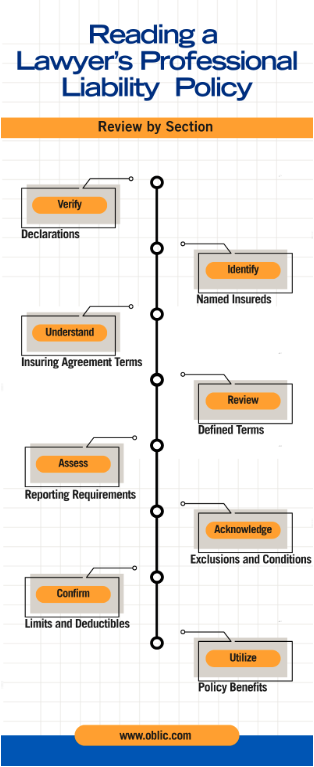
A lawyer’s professional liability insurance policy is more than a declarations page. The declarations summarize key details such as the policy period, limits, deductible, and premium. But the insuring agreement, definitions, exclusions, conditions, and endorsements determine how coverage operates. The sections should be read together to understand who is insured, which professional services are addressed, when a matter is reported, and how the policy may respond to a claim.
This guide walks through the major sections of a lawyers’ professional liability policy and the questions Ohio attorneys should ask when purchasing, renewing, or changing coverage.
Start With the Declarations Page
The declarations page is a useful starting point because it summarizes many of the policy’s details. It usually identifies the named insured, policy period, limits, deductible, and endorsements. When reviewing the declarations, confirm:
- The firm’s legal name and address are correct
- The policy period is accurate
- The per-claim and aggregate limits match the coverage selected
- The deductible is correct
- The applicable retroactive or prior-acts date is listed accurately
- All expected endorsements are identified
- The issuing insurer and policy number are correct
Even a small discrepancy is worth addressing. A law firm that has changed names, added or removed an attorney, moved offices, or reorganized its ownership structure should confirm that its policy information reflects its current operations.
The declarations page is a summary, not a substitute for the full policy. Terms appearing there may be explained or limited elsewhere, so the rest of the policy should be reviewed carefully.
Review Who Qualifies as an Insured
In an OBLIC LPL policy, the named insured is the law firm identified on the declarations page, and insured attorneys are listed in a schedule that identifies each attorney’s coverage dates and full- or part-time status. An attorney’s title or relationship with the firm does not itself establish coverage; firm attorneys must be included on the insured schedule. Firms using contract lawyers or of-counsel arrangements should discuss how those relationships are addressed with their insurance professional.
When a lawyer joins or leaves the firm, the firm should also consider how the change affects coverage for past and ongoing work. Because coverage is evaluated under the policy in effect when a claim is made, firms should consult their insurance professionals about continuity of coverage when adding or removing a lawyer.
Understand the Insuring Agreement
The insuring agreement describes the insurer’s primary coverage obligation and the basic requirements that must be satisfied before coverage applies. When reading the it, ask:
- What type of allegation or demand may qualify as a claim?
- Must the claim arise from defined professional services?
- When must the claim be made?
- When must it be reported?
- Must the alleged act, error, or omission occur on or after a specified prior-acts date?
- How are damages and claim expenses treated?
- Is coverage subject to a per-claim or aggregate limit?
The insuring agreement should not be read alone. Its terms are shaped by the policy’s definitions, exclusions, conditions, and endorsements.
Pay Close Attention to Defined Terms
Lawyers understand how much a defined term can influence the interpretation of a contract. Words that have an ordinary meaning may carry a narrower or more specific meaning under the policy. Pay particular attention to:
Claim
A “claim” may include more than a filed lawsuit. Depending on the language in the policy, it could include a written demand, a request for monetary relief, a request for nonmonetary relief, or another proceeding described in the definition. The precise wording matters because it affects when reporting obligations begin. If an insured attorney is not certain whether an incident or situation has developed into a claim, OBLIC encourages policyholders who are uncertain whether a matter may constitute a claim to report it promptly for evaluation.
Professional Services
This definition of “professional services” identifies the work or activities within the policy’s scope. In an LPL policy, covered professional services address legal services performed for clients and other activities specifically listed in the policy.
Attorneys who provide nonlegal consulting, investment advice, or other outside services should not assume those activities are included.
Insured
This definition identifies which individuals and entities may qualify for coverage. Review the definition when paraprofessional staff and attorneys join or leave the firm or the firm changes structure.
Damages and Claim Expenses
These definitions identify which monetary amounts and defense-related expenses are addressed or excluded. They also help explain how claim expenses interact with limits and deductibles. When accepting a quote, policyholders should determine whether to select outside or inside limits coverage as it affects limits available for liabilities or damages.
Related Claims
The policy may explain when multiple claims, allegations, or demands are treated as a single claim. This can affect the applicable policy period, deductible, and coverage limit. Because the analysis is fact-specific, potentially connected matters should be reported promptly for evaluation.
Review the Policy’s Reporting Requirements
Most lawyers’ professional liability policies are written on a claims-made-and-reported basis, making timing central to coverage.
A policy may require a claim to be both made against the insured and reported to the insurer during the applicable policy period or another period permitted by the policy.
What Events Require Notice?
Depending on the policy, for a claim to be covered, reporting obligations may arise from:
- A lawsuit or arbitration demand
- A written demand for money or services, including a request that an attorney correct or pay for an alleged error
- A disciplinary complaint
A client does not need to use the word “malpractice” for a reporting obligation to arise.
Likewise, telling a colleague, outside counsel, broker, or local agent may not satisfy the policy’s notice requirement unless notice is submitted in the manner required by the policy.
How Must Notice Be Submitted?
For a claim to be properly reported, the policy may specify:
- Where notice must be sent
- What information must be included
- Whether written notice is required
- Which method(s) of contact is accepted
- When notice is considered received
Attorneys should retain a copy of the notice and written confirmation that it was received.
When Should a Lawyer Report a Possible Claim?
Attorneys should review the policy and contact the insurer promptly when they become aware of a claim or circumstance that may require notice. Prompt reporting allows the insurer to evaluate the matter and determine what assistance may be available.
Understand How Related Claims May Be Treated
Depending on the policy language and facts, claims involving related acts, clients, transactions, or circumstances may be treated as a single claim. For example, several demands arising from the same transaction, representation, or course of conduct may be considered related even if they are made by different parties or at different times. Potentially connected claims should be reported promptly so the insurer can evaluate them under the applicable policy language.
Read Exclusions Together With the Coverage Grant
Exclusions identify circumstances outside the policy’s coverage, but they should not be reviewed as a standalone checklist. A more useful analysis is to:
- Identify the applicable insuring agreement.
- Review the relevant definitions.
- Consider whether an exclusion applies.
- Determine whether an endorsement modifies that exclusion.
A matter may fall outside coverage because it is not within the initial coverage grant or because an exclusion applies. Some exclusions also depend on an insured’s knowledge, conduct, relationship, or financial interest. Because coverage depends on the full policy and the facts of the claim, attorneys should avoid reaching a final conclusion based on one sentence or provision.
Understand the Conditions You Agree to Follow
The conditions section describes obligations that may apply to the insured and insurer as a claim is reported, investigated, defended, and resolved. Common policyholder obligations may include:
- Providing prompt notice
- Cooperating with the insurer and supplying requested documents and information
- Obtaining consent before making payments, admissions, or settlements
- Preserving records related to the claim
- Maintaining accurate information in the insurance application
These are substantive obligations, not administrative details. Attorneys facing a possible claim should preserve the file, avoid altering records, and contact the insurer before reimbursing a client, waiving fees, admitting fault, or resolving the dispute independently.
Understand How Limits and Deductibles Apply
Review how defense costs and the deductible affect the coverage available for a claim. If defense costs are paid within the policy limit, those expenses reduce the amount remaining for a covered settlement or judgment. If defense costs are paid outside the limit, they generally do not reduce the amount available for damages.
The deductible may apply to damages, claim expenses, or both. The policy may also establish different deductibles or sub-limits for certain coverages or types of claims.
Because these provisions vary among policies, review the declarations, policy form, and applicable endorsements together. Endorsements may modify the standard terms, including the limits, deductible, or treatment of claim expenses.
Review Your Professional Liability Coverage With OBLIC
A lawyer’s professional liability policy should be read as a complete contract.Reviewing only the premium, deductible, or policy limits can leave important questions unanswered. A more complete review helps attorneys understand who is insured, which services are addressed, what must be reported, and which obligations apply.
For nearly 50 years, OBLIC has focused exclusively on serving Ohio lawyers and law firms. Our Ohio-based team provides clear explanations and responsive support during the application, renewal, and claims-reporting processes. If you have questions about your current professional liability policy, an upcoming renewal, or coverage for your Ohio law practice, contact OBLIC to speak with a member of our team.