
What Small Law Firms Should Know About Tail Coverage
If you’ve practiced law for any length of time, you’ve probably heard the term tail coverage. Known colloquially as “tail” insurance, an extended reporting endorsement (or extended reporting period) is an important aspect of malpractice insurance coverage that can provide protection from claims arising after a policy expires.
Over the years as we’ve worked with attorneys at every stage of their careers, one observation continues to stand out: conversations about professional liability insurance often focus on obtaining coverage, while less attention may be given to what happens when coverage ends.
In this article, we’ll explain how tail coverage operates upon retirement, transition between firms, or exiting private practice, how tail coverage differs from prior acts coverage, and the questions every small law firm should ask before making a significant practice transition.
What Is Tail Coverage?
Professional liability insurance for lawyers is commonly written on a claims-made-and-reported basis. Unlike an occurrence-based policy, a claims-made-and-reported policy generally requires that a covered claim be made and reported while the policy is in force. But this is where “tail” coverage provides significant benefit.
Tail coverage, formally called an extended reporting endorsement, generally allows covered claims arising from legal services performed while a claims-made-and-reported professional liability policy was in effect to be reported after that policy has ended, for a duration of time determined at the time of purchasing the coverage.
Put another way, the American Bar Association describes an extended reporting endorsement as a mechanism that allows claims to be reported after a claims-made-and-reported policy expires, rather than extending the policy period itself.
Tail coverage does not provide insurance for future legal work. This distinction is one of the most important concepts for attorneys to understand when evaluating professional liability coverage during a career transition.
How Long Does Tail Coverage Last?
Tail coverage does not have one standard duration. The reporting period depends on the extended reporting endorsement selected when the underlying professional liability policy ends.
OBLIC offers tail coverage for one year, two years, three years, or an unlimited period. The appropriate duration can depend on factors such as the attorney’s area of practice, the type of legal work previously performed, and the potential application of Ohio’s statute of repose for legal malpractice claims.
The one-year Ohio statute of limitations for legal malpractice claims begins to run upon the later of the discovery of the error or the end of the representation. Within some areas of practice, a potential error can lie dormant for years, and for others it is discovered in quick order. The Ohio statute of repose places a maximum limit of four years within which to file suit (although longer in certain limited circumstances) from the date of the act, error or omission, regardless of whether the error was discovered.
Because of these differences, attorneys should consider the duration of tail coverage as part of their retirement or practice-transition planning rather than assuming that the same extended reporting period is appropriate for every lawyer.
Why Tail Coverage Matters for Solo and Small Firm Attorneys
We’ve noticed that many solo and small firm attorneys naturally focus on maintaining coverage throughout their careers, but fewer think about how their policy responds after they retire, leave a firm, or change insurance carriers. Legal matters handled years prior to a transition can result in allegations requiring a response.
For example, a lawyer may have completed estate planning documents, closed a real estate transaction, or finalized a business acquisition years before retiring. If a claim related to that prior representation is first made after the lawyer’s claims-made-and-reported policy has ended, the ability to report that claim may depend on whether the firm is still in existence, or for solos, if the attorney obtained tail coverage at the time of retirement.
For solo practitioners, retirement often means closing the firm and ending its professional liability policy. Unlike an attorney retiring from a firm that continues to operate and maintain coverage, a solo may have no continuing policy to respond to claims arising from prior work. Tail coverage can therefore be especially important when winding down a solo practice.
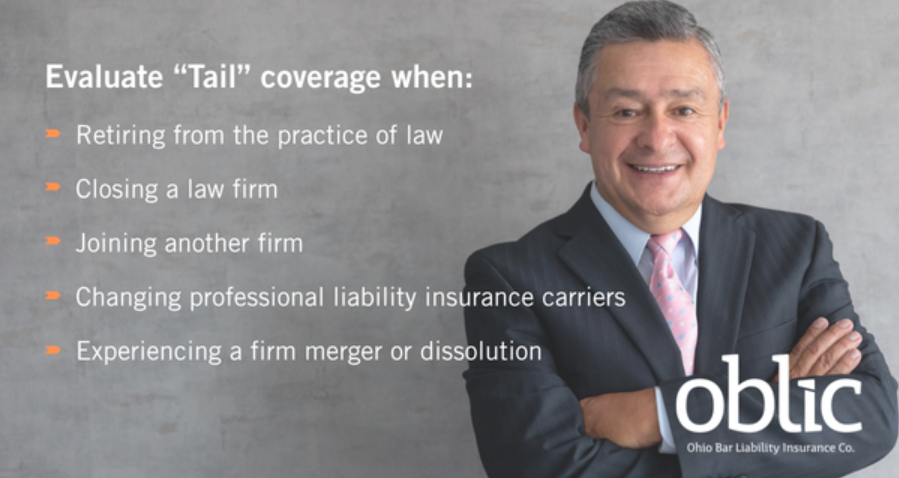
tail coverage through oblic
When Ohio Lawyers Should Consider Tail Coverage
Most attorneys don’t think about tail coverage until they’re preparing for a major career or practice transition. We’ve found that reviewing your professional liability coverage early gives you more time to understand your options and plan for continuity of coverage.
Retirement and Closing a Law Practice
Retirement is one of the most common times attorneys evaluate tail coverage. Although you are no longer accepting new clients or new matters, claims related to prior legal work can still arise.
Changing Law Firms
When joining a new firm, understand how prior work will be covered both under the prior firm’s and the new firm’s insurance policy. While the prior firm’s policy may respond to claims arising from work performed while employed there, a lawyer in transition should understand whether that prior policy will respond, whether they can request prior acts with the new policy, or whether they should individually consider an extended reporting endorsement.
Changing Insurance Carriers
If your firm changes professional liability insurance carriers, it’s important to understand how coverage transitions from one policy to the next. Reviewing retroactive dates, prior acts provisions, and other policy terms can help maintain continuity of coverage.
Firm Mergers or Dissolutions
Mergers, acquisitions, and firm dissolutions often involve complex insurance considerations. Reviewing professional liability coverage early in the process can help attorneys understand how prior legal work will be addressed during the transition.
Tail Coverage vs Prior Acts Coverage
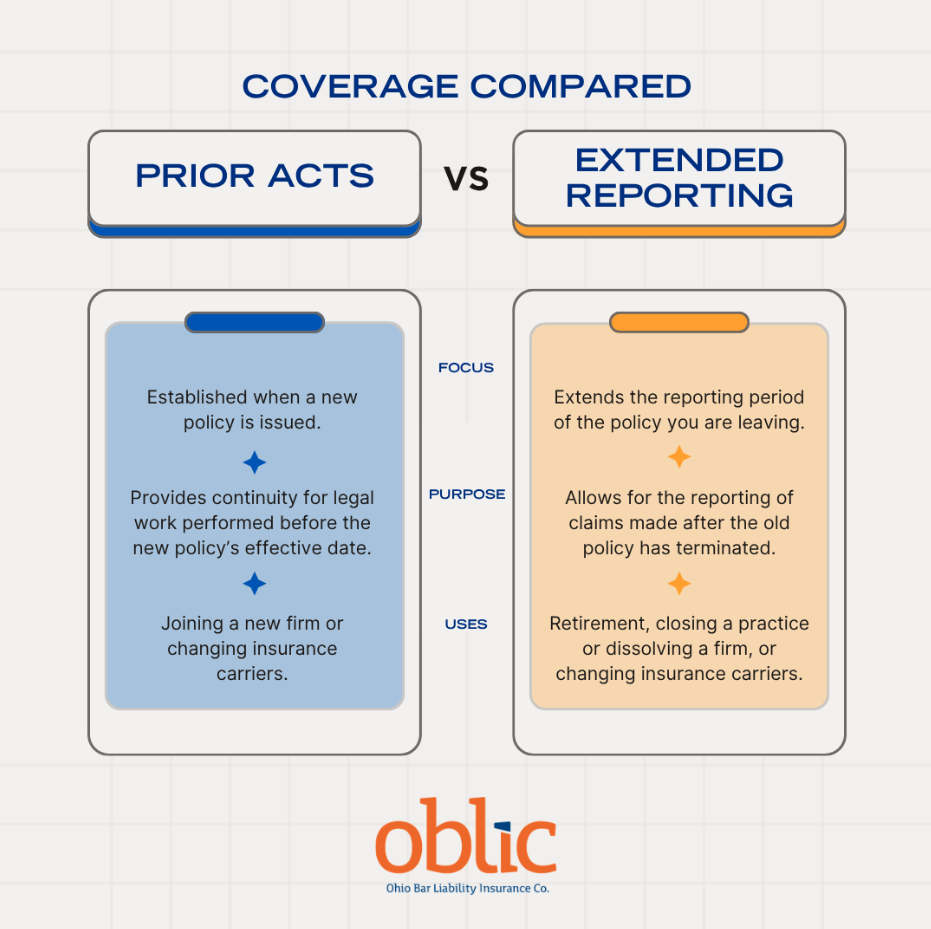
While both tail coverage and prior acts coverage help address legal work performed in the past, they function differently and are used in different situations. The simplest way to think about the difference is this:
- Tail coverage extends the reporting period under the policy you are leaving, allowing certain covered claims to be reported after that policy ends.
- Prior acts coverage is part of the new policy you are purchasing and is generally intended to provide continuity for covered legal work performed before the new policy became effective, provided the policy includes an appropriate retroactive date and other applicable requirements are met.
The distinction becomes especially important during career and practice transitions. For example, if you’re joining a new law firm or changing insurance carriers, your new policy may include prior acts coverage that addresses work performed before the policy’s effective date.
In some cases, that may change the need for separate tail coverage. In other situations—such as retirement or closing a practice—tail coverage may be the more appropriate option.
Why Ohio Lawyers Work with OBLIC
Choosing professional liability insurance means choosing a partner that understands the realities of practicing law. For nearly 50 years, OBLIC has focused exclusively on serving Ohio lawyers and law firms, giving us deep experience with the professional liability issues and career transitions attorneys encounter.
We work with lawyers throughout the life of their practices—from opening a firm and changing firms to succession planning and retirement. Along with lawyers’ professional liability insurance, we provide practical risk management resources, educational programs, and responsive guidance when questions arise.
Whether you’re considering tail coverage, preparing for a transition, or planning ahead, OBLIC can help you understand your coverage options and make informed decisions about protecting your practice.
Tail Coverage: Frequently Asked Questions
Does tail coverage cover future legal work?
No. Tail coverage generally applies only to covered claims arising from legal services performed before the underlying claims-made policy ended. Legal services performed afterward require separate coverage. Tail coverage addresses prior work; it does not replace ongoing malpractice insurance for your current practice.
What happens if I change law firms?
Coverage for work performed at your previous firm depends on the terms of the applicable policies. That work may remain covered under your former firm’s policy, or your new firm’s policy may provide applicable prior acts coverage. Because coverage can vary, changing firms is a good time to review how your prior work will be protected.
Who pays for tail coverage?
Responsibility for tail coverage depends on the circumstances. It may be addressed in an employment or partnership agreement, firm policy, or negotiated as part of a lawyer’s departure. Attorneys who may need to purchase tail coverage should account for that cost when planning a transition.
How can I determine whether I need tail coverage?
Start by reviewing your current professional liability policy and discussing your plans with your insurance professional. Consider:
- Is my current policy claims-made-and-reported?
- Am I retiring, changing firms, or changing carriers?
- Will another policy provide prior acts or career coverage?
- Could there be a gap in coverage?
- Does an employment or partnership agreement address tail coverage?
If you’re planning a transition, OBLIC can help you understand how your coverage may respond and what options are available.
Questions About Professional Liability Coverage?
Career transitions often involve important insurance decisions. Whether you are retiring, changing firms, or evaluating your professional liability coverage, understanding how your policy responds during those transitions is an important part of protecting your practice. OBLIC has focused exclusively on serving Ohio lawyers for nearly 50 years. If you have questions about professional liability coverage, tail coverage, or other policy considerations, our team is available to help you understand your options.
Contact OBLIC to discuss your professional liability coverage and practice transition plans.