
A Common Billing Shortcut Creates Trust-Accounting Problems
Applying client funds from one matter to another can trigger trust-account and ethics issues. Read on to learn why the practice of cross-matter setoff is risky and how to avoid pitfalls.
This piece is part of a series discussing Fee Agreements. In prior articles, we covered fee types, retainers, alternative fee models, and fee agreement upgrades. This week we dive into a particular billing nuance related to gaining client consent. In upcoming articles, we’ll cover other elements to include in your Fee Agreements on scope & clarity of services and offboarding & file management.
It’s not unusual for a lawyer to receive funds for a client while a prior invoice remains unpaid. When the client legitimately owes the money, applying those funds can seem efficient and harmless.
The risk arises when the funds are associated with a different matter. Without clear contractual authority and informed client consent, using money associated with one engagement to satisfy fees from another can constitute improper handling of client trust funds.
What Is Cross-Matter Setoff?
Cross-matter setoff occurs when a lawyer applies funds received in one matter to fees owed in another matter. However, even where fees are legitimately owed on one matter, the question is whether the client has authorized the lawyer to use funds held in trust to pay it.
At the core of this analysis is the principle that funds held in trust are the client’s – and not the lawyer’s – and it is the client who has consented to their use in accordance with the terms of the fee agreement. Attorneys and clients must be clear about the purpose and use of retainer deposits – can they be used for any matter associated with the client, or are they ear-marked for a specific matter?
Examples, an Advisory Opinion, and a Grievance
These situations are ubiquitous in practice. Take for example the following scenario:
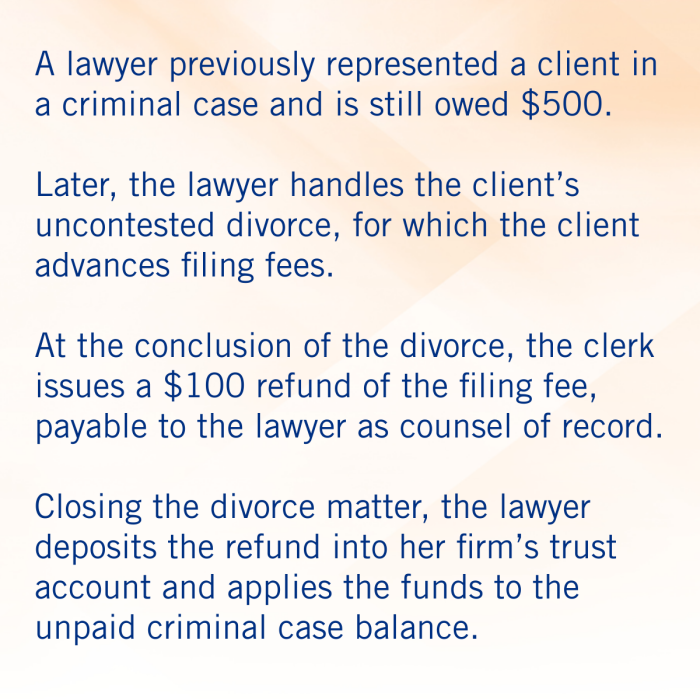
Did the lawyer’s use of the funds exceed her authority? Without consent from the client, the unearned funds in connection with the divorce most properly should have been refunded to the client at the conclusion of the matter as required by Ohio Professional Conduct R. 1.16(e). In the event of a disagreement as to the disposition of funds held in trust, or a third-party including the lawyer asserts a claim to the funds, then the attorney must follow steps required by R. 1.15(e), holding the disputed funds in trust until resolved while ensuring that undisputed funds are promptly disbursed.
The South Carolina Bar was asked to weigh in on another common fact pattern involving cross-matter setoffs:
- A law firm was hired by a client for two matters, and received a retainer for one of the two matters, depositing the funds into IOLTA.
- The firm performed work on both matters, billing the client accordingly.
- For the matter which the firm had received trust funds, the firm applied the funds in trust to the balance owed on that matter.
- The other invoice went unpaid and eventually the client became uncommunicative despite the firm’s efforts.
The firm asks whether they can use funds remaining in trust associated with one matter to pay the outstanding balance on the other matter. The South Carolina Bar opined in Ethics Advisory Opinion 12-01 that the firm does not have authority to engage in a cross-matter set-off in this situation. Clarifying that the firm had received a specific retainer for one matter, and not a general retainer for all work representing the client, the Opinion identifies that, absent the client’s consent or agreement to use the funds from one matter to cover fees in a separate matter, the retainer deposited are refundable to the client if not used in connection with the matter for which they were deposited.
Not unsympathetic to lawyers, the Opinion states:
As a matter of fairness and expedience, there is some appeal to the argument that counsel should be able to offset overpayment on one matter against underpayment on another. However, review of the Rules cited above suggests that an unearned fee remains an unearned fee, even if the lawyer has an equitable claim to the funds by virtue of having performed uncompensated work on another matter.
Finally, we also see the peril of cross-matter set-off in a disciplinary matter in New Jersey, In re Cameron, 221 N.J. 238 (2015), cited by In re Maziarz, N.J. Disciplinary Review Board Docket No. DRB 18-251 (2019). Cameron received an $8,000 retainer in connection with a client’s mortgage pay-off. He subsequently applied $3,500 of those funds to a past due bill for a different matter involving the same clients. Forgetting that he had withdrawn a portion of the funds intended to pay off the mortgage, he distributed $8,000 out of trust, which invaded other clients’ funds held in trust. Determining that various recordkeeping deficiencies resulted in negligent misappropriation, the attorney was reprimanded for his violations of R. 1.15.
Best Practices
It’s important to again underscore that funds received in connection with a particular matter remain client property until they are properly earned or applied as authorized. Strong client communication, a healthy trust-based relationship, and clear, predictable billing practices all underpin a win-win solution.
Beyond good communication and billing practices, proactive, well-drafted representation agreements may also quietly prevent this problem by:

The Takeaway
Cross-matter setoff is rarely about bad intent. It’s about scope, consent, and fiduciary duties.
If you receive funds tied to a specific matter, treat them that way unless you have clear, informed, written authorization to do otherwise. When in doubt, pause, notify the client, and document consent before applying funds.
A few extra steps up front can save you from breaching trust with your client and ethics violations.
| Gretchen K. Mote, Esq. Director of Loss Prevention Ohio Bar Liability Insurance Co. Direct: 614.572.0620 gmote@oblic.com |
Merisa K. Bowers, Esq. Director of Marketing and Loss Prevention & Outreach Counsel Ohio Bar Liability Insurance Co. Direct: 614.859.2978 mbowers@oblic.com |
See related articles:
Withdrawing from Representation (8/31/22)
IOLTA Reminders & Resources (4/6/22)
Flat Fee Agreements (5/6/21)
This information is made available solely for loss prevention purposes, which may include claim prevention techniques designed to minimize the likelihood of incurring a claim for legal malpractice. This information does not establish, report, or create the standard of care for attorneys. The material is not a complete analysis of the topic and should not be construed as providing legal advice. Please conduct your own appropriate legal research in this area. If you have questions about this email’s content and are an OBLIC policyholder, please contact us using the information above.