

When Representation Ends: How to Return Unearned Fees
What Happens to Client Funds When Representation Ends?
When representation ends, any unearned portion of a fee paid in advance (retainer) must be returned to the client.
This obligation applies whether the matter concludes as planned, the client terminates the relationship, or the lawyer withdraws. At that point, funds held in trust remain client property unless and until they have been earned.
Failing to address this step promptly can turn an otherwise routine conclusion into a client complaint or disciplinary issue.
What Must Be Returned — and When
Under Ohio Rule of Professional Conduct 1.16(e), a lawyer must refund any unearned portion of a fee upon termination of representation.
Rule 1.15(d) also requires that, upon receiving funds in which a client or third person has an interest, the lawyer must promptly notify the client or third person, deliver any funds they are entitled to receive, and provide an accounting upon request.
In practice, this requires:
- Determining what portion of the fee has been earned
- Notifying the client of the final balance
- Providing an accounting, if requested
- Promptly returning any remaining funds
The timing matters. Once representation ends and the accounting is complete, funds should not remain in trust without a clear basis.
Common Pitfalls at File Closing
Problems at the end of representation may be procedural, not intentional.
Common issues include:
- Leaving residual funds in trust after a matter concludes
- Failing to issue a final invoice
- Delaying refunds pending administrative follow-up
- Treating flat fees as fully earned without analysis
- Failing to communicate the final balance clearly
Even small unresolved balances can lead to client concerns if not addressed.
Lessons from Disciplinary Cases
Ohio disciplinary decisions involving unearned fees typically reflect more than simple oversight. They often involve poor communication, failure to follow requirements in the Rules of Professional Conduct, financial mismanagement, and, in some cases, dishonesty.
In Disciplinary Counsel v. K.D. (2021-0209), the lawyer failed to properly account for and return unearned fees, contributing to disciplinary action. The issue was delay coupled with lack of transparency in handling client funds.
More recent decisions reinforce these concerns. In 2025-Ohio-2406, the Court addressed misconduct that included failure to refund unearned fees, along with broader issues of neglect and misrepresentation.
These cases are not about minor accounting errors. They reflect situations in which lawyers did not manage client funds appropriately or failed to follow through on basic obligations at the outset and end of representation.
The takeaway is direct: client funds must be accounted for accurately and returned promptly. When that does not occur, the consequences can extend beyond client disputes to professional discipline.
Build Financial Reconciliation into File Closing
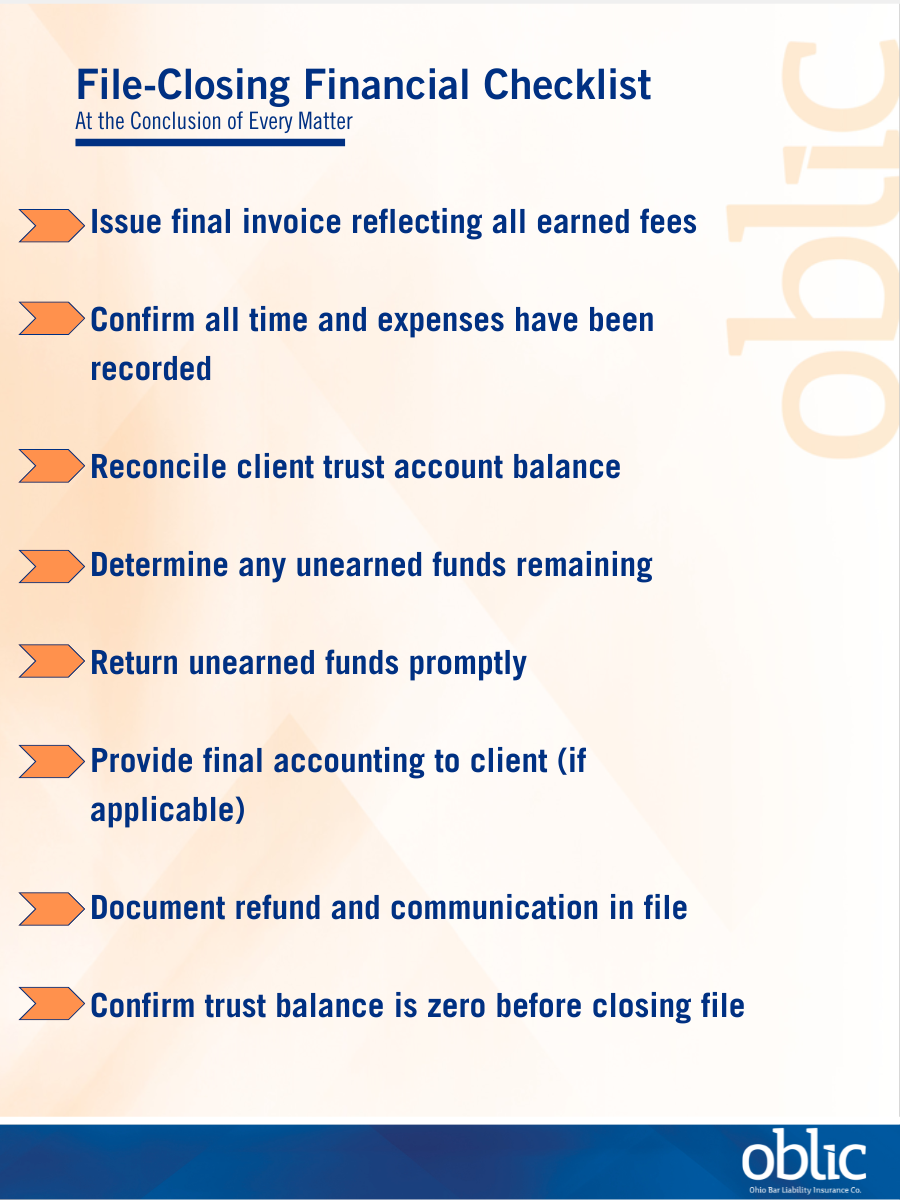
The most effective way to avoid problems is to treat financial reconciliation as a required step in closing every file.
At the conclusion of representation, firms should:
- Issue a final invoice reflecting earned fees
- Reconcile the client’s trust account balance
- Return any unearned funds promptly
- Document the accounting and client communication
If there is a dispute regarding entitlement to funds, Rule 1.15(e) requires that the disputed portion remain in trust until the issue is resolved, while any undisputed funds must be promptly distributed.
This process does not need to be complex, but it must be consistent. When applied uniformly, it ensures compliance and prevents funds from being overlooked or improperly held.
Best Practices Strengthen Your Practice
Returning unearned fees is part of the lawyer’s duty to safeguard client property.
Clear engagement terms, regular billing, and disciplined trust account management make this final step straightforward. As discussed in OBLIC’s article “Billing Without Friction: Fee Agreement Essentials,” clear fee agreements and defined payment expectations reduce confusion and prevent disputes before they arise.
When those expectations are established at the outset, there is far less uncertainty when representation ends.
A defined file-closing process — including financial reconciliation — reduces risk and reinforces professionalism.
This article continues OBLIC’s “Getting Paid” series, focusing on practical strategies that support both ethical compliance and effective law practice management.
The end of representation should be handled with the same care as the beginning. Promptly returning unearned fees ensures the financial relationship concludes on clear and professional terms. Questions? We can help – contact the Loss Prevention Hotline for guidance or to schedule an ethics consult.
| Gretchen K. Mote, Esq. Director of Loss Prevention Ohio Bar Liability Insurance Co. Direct: 614.572.0620 gmote@oblic.com |
Merisa K. Bowers, Esq. Director of Marketing and Loss Prevention Counsel Ohio Bar Liability Insurance Co. Direct: 614.859.2978 mbowers@oblic.com |
This information is made available solely for loss prevention purposes, which may include claim prevention techniques designed to minimize the likelihood of incurring a claim for legal malpractice. This information does not establish, report, or create the standard of care for attorneys. The material is not a complete analysis of the topic and should not be construed as providing legal advice. Please conduct your own appropriate legal research in this area. If you have questions about this email’s content and are an OBLIC policyholder, please contact us using the information above.